The Evolution of Battle Royale: From Mod to Mainstream
The battle royale genre has become one of the most dominant forces in modern gaming, captivating hundreds of millions of players and generating billions in annual revenue. But the journey from humble beginnings to global phenomenon is a story of modders, streamers, and timing — and its lessons still shape how games are made today.
The origins: a modding experiment
Battle royale didn't start with a major studio or a big budget. Its modern form traces back to the mod scene of the early 2010s — most famously Brendan "PlayerUnknown" Greene's battle royale mods for ARMA 2 and ARMA 3, themselves inspired by the Japanese novel and film Battle Royale. Minecraft's "Hunger Games" survival servers and the DayZ mod community were running parallel experiments with the same core tension: many players, scarce resources, one survivor.
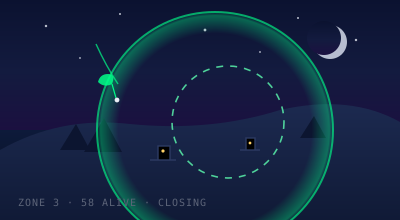
The formula was deceptively simple. Drop a large number of players into a shrinking play area, scatter weapons and gear, and let the circle force confrontation. It tapped into a primal competitive instinct while adding two things deathmatch never had: the dread of the closing zone and the gambler's thrill of looting.
Breaking into the mainstream
The turning point came when the concept graduated from mod to standalone product. PUBG's 2017 early-access launch proved the format could carry a full game, selling tens of millions of copies and shattering Steam concurrent-player records. Months later, Fortnite bolted a battle royale mode onto its co-op survival game, made it free, and reached an audience no premium title could touch.
Streaming was the accelerant. Battle royale is inherently watchable — every match builds to a climax, upsets happen constantly, and a viewer can join mid-stream and understand the stakes in seconds. Twitch and YouTube turned matches into content, content into curiosity, and curiosity into downloads. The genre and the streaming economy grew each other.
The global phenomenon
When the biggest publishers entered — Call of Duty with Warzone, Apex Legends from Respawn — they brought production values and marketing muscle that pushed the genre further into the mainstream. Free-to-play removed the last barrier to entry, while battle passes and seasonal content created the retention loops that now define live-service design.
Mobile finished the job. PUBG Mobile, Free Fire, and Fortnite on phones brought the genre to markets where consoles and gaming PCs are rare, pushing player counts into the hundreds of millions. Short matches and instant drama made battle royale a natural fit for how people actually play on phones.
Innovation and evolution
Maturity brought variation. Fortnite's building system, Apex's movement and ping communication, Warzone's respawn Gulag, and Fall Guys' non-violent spin each answered the same design question differently: how do you keep "last one standing" from meaning "sit in a bush for twenty minutes"? The best innovations pulled players toward action without abandoning the tension that defines the genre.
Esports proved harder. A hundred players across a huge map is a broadcasting nightmare compared to a five-on-five match on a fixed map, and battle royale tournaments have had to invent new formats, point systems, and spectator tools to make the chaos legible.
Where the genre goes next
Today battle royale is less a category of standalone games and more a design vocabulary the whole industry borrows. Extraction shooters take its looting tension. Live-service games of every genre run its seasonal playbook. New entries must clear a far higher bar than 2017's — players now expect polish, constant updates, and a reason to choose a new circle over the ones they've mastered.
The genre's rise remains one of gaming's best case studies: innovation can come from anywhere, streaming can make a genre, and the right idea at the right moment can reorganize an entire industry. The mod scene wanted to try something different. The rest of the industry is still catching up.