The Complete Beginner's Guide to Competitive FPS
Every competitive shooter — Counter-Strike 2, Valorant, Apex Legends, Overwatch 2 — rewards the same small set of fundamentals. New players usually skip them and grind ranked instead, which is why so many people play hundreds of hours without improving. This guide covers the four things that actually move your rank: crosshair placement, deliberate aim practice, movement discipline, and how you review your own play.
1. Crosshair placement beats raw aim
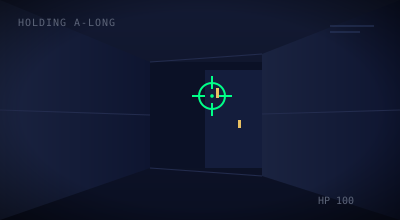
The biggest gap between new and experienced players isn't reaction time — it's where the crosshair sits before the fight starts. Experienced players keep the crosshair at head height, pre-aimed at the corner an enemy is most likely to appear from. When someone peeks, they only need a tiny adjustment. New players stare at the floor or the middle of a wall and have to do a huge flick under pressure.
Practice it deliberately: as you move through a map, ask "if someone appeared right now, where would their head be?" and keep the crosshair glued there. This single habit is worth more than any amount of aim-trainer grinding, and it costs nothing but attention.
2. Aim training that isn't a waste of time
Aim trainers like Aim Lab and KovaaK's help, but only used correctly. Fifteen focused minutes before you play beats two zoned-out hours. Structure a short warmup around three skills:
- Static clicking — precision on stationary targets, the foundation for tap-fire games like Valorant and CS2.
- Tracking — keeping the crosshair on a moving target, essential for Apex and Overwatch.
- Target switching — snapping cleanly between multiple targets, which is what real multi-enemy fights demand.
One rule matters above all: pick a sensitivity and stop changing it. Muscle memory is the entire mechanism of aim improvement, and every sensitivity change resets it. Most competitive players end up somewhere between 25–45 cm of mousepad per full 360° turn. Pick something in that range, lower than feels natural, and commit for at least a month.
3. Movement is a defensive weapon
New players treat movement keys as transportation. Good players treat them as a survival tool. Three habits to build immediately:
- Stop before you shoot. In tactical shooters, moving while firing sends your bullets everywhere. Learn to counter-strafe (tap the opposite direction key) so you're accurate the instant you fire.
- Clear corners one at a time. Wide-swinging into an open area exposes you to five angles at once. Slice each angle individually.
- Don't repeek the same spot. If you peeked and took damage, the enemy's crosshair is now waiting exactly where your head just was. Move, then peek somewhere else.
4. Game sense is learnable, not magic
"Game sense" is mostly information discipline. Sound is the biggest source: play with decent headphones and stop running everywhere — in most tactical shooters, running is loud and walking is quiet. Learn the timings: how long it takes the enemy to reach each key position from spawn tells you when a quiet flank is safe and when it's a trap.
Second, track the economy of information: every death on your team is a report of where the enemy is. Every silent area of the map is information too. Ask one question constantly — "given what we've seen, where are the people we haven't seen?"
A weekly routine that actually works
- Daily (15 min): aim warmup — 5 minutes each of clicking, tracking, switching.
- Every session: pick one focus (crosshair placement, or not repeeking, or sound discipline). Grade yourself only on that.
- Weekly (30 min): review one of your own losses. Skip to your deaths and ask what information you had before each one. Most deaths are decision errors, not aim errors — the replay will prove it.
- Play fewer, better matches. Three focused games beat eight tilted ones. Ranked while frustrated is how losing streaks happen.
The honest timeline
With deliberate practice, most new players see real improvement in 4–6 weeks and climb out of beginner ranks within a season. Without it, people plateau for years. The difference isn't talent or hours — it's whether each session has a specific purpose. Pick your game, lock your sensitivity, and start with crosshair placement tonight.